


Nutrition of the vine to obtain good quality wine
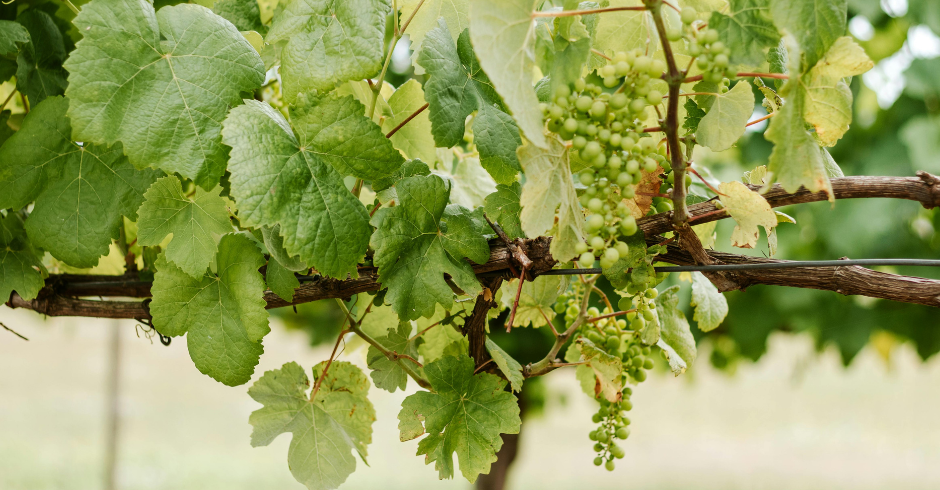
Most Italian grape varieties have now entered the stage of berry enlargement / pre-veraison. The aim is to ensure the berries develop fully, whilst avoiding stressful conditions that could encourage the onset of pathogens:
To achieve balanced development whilst keeping the plant physiologically active, we recommend:
• CalcioMagno 15–20 l/ha (1–2 fertigation every 15 days)
• VigorGreen 1.5 l/ha + Magnetical 3–4 l/ha (1–2 foliar applications every 15 days)
During the subsequent veraison phase, it is important to keep the foliage green and active despite the high temperatures and to start managing the Brix level, whilst avoiding over-ripening, which impairs the wine’s organoleptic qualities. Here too, biostimulants are recommended to boost photosynthesis and ensure uniform ripening and colour:
• Glycos Plus 2 l/ha + Magnetical 3–4 l/ha (3 foliar applications every 20 days)
From an agronomic perspective, these recommendations may be considered sufficient to reach harvest, but when the oenological aspect is also taken into account, several studies (e.g. Mataffo et al. 2020, Canaura et al. 2018) have shown that a complete and uninterrupted fermentation process requires an optimal concentration of Readily Assimilable Nitrogen (known as RAN). A low concentration of RAN in the grape must slows down fermentation (even bringing it to a halt in the most severe cases) and leads to the presence of undesirable compounds in the wine, causing a detrimental alteration of its aromatic profile.
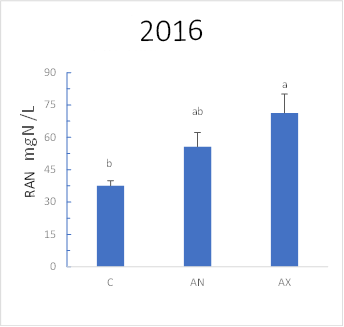
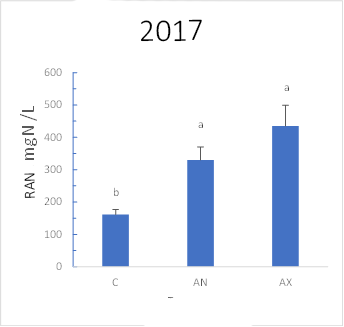
In Mataffo’s study of a vineyard (Greco variety) located in southern Italy, two products were tested, both applied in the same quantity and containing both organic and mineral nitrogen but in different concentrations: one with a higher mineral nitrogen (AN) content and the other with a higher organic nitrogen (AX) content.
The treatments carried out at the start of veraison and after veraison did not result in any significant differences compared with the untreated control; however, the applications made at complete veraison yielded significantly better results in both years (higher RAN content in the must; Graph. 1)
Cerea FCP recommends the use of two alternative products, to be applied from the onset of veraison until full veraison, in order to increase the must’s RAN and to further enhance the ripening process (increasing the Brix degree) and the accumulation of aromatic and phenolic compounds in the grapes.
- GIOVE BIO GOLD (16.0.0): a water soluble fertiliser with a plant-stimulating effect (approved for use in organic farming), entirely plant-based, characterised by a high content of amino acids and nitrogen. Its composition allows it to be rapidly absorbed by the crop; the product also helps to reduce abiotic stress and increase the Brix level of the grapes (22% consists of organic matter).
Recommended dosage: two foliar applications (1,5-2 Kg/ha), one at the mid-veraison stage and one at full veraison.
or:
- LEAF N-FAST (18.0.0): a liquid fertiliser composed of urea nitrogen (rapid absorption), magnesium chelated with ligninsulfonate, and sulphur. The magnesium contributes to chlorophyll synthesis. The presence of ligninsulfonate (natural substances of biological origin) in the formulation ensures better distribution on the leaves, greater resistance to leaching and prevents phytotoxicity even at high doses.
Recommended dosage: two foliar applications (5 l/ha) at the start of veraison and at full veraison.
The recommended application rates, combined with a close observation of the crop’s physiological condition (vigor, leaf colour and bud fertility), should be regarded as a starting point for identifying the most effective nutritional strategy over time and for refining agronomic practices.
Do you want to discover the complete technical line for the grapevine?