


Glycos plus: improves fruit colour in apple trees, table grapes and other crops
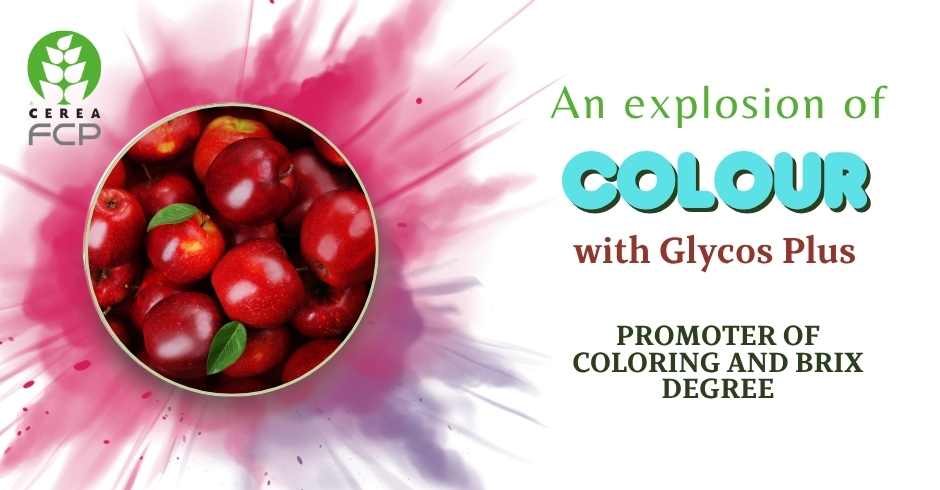
During 2023, a fertilisation trial was set up in collaboration with the Technology Transfer Centre of the Edmund Mach Foundation in San Michele all’Adige (TN), on the Fuji/M9 cultivar in the Spagolle area of the municipality of Castelnuovo (TN), to test the performance of FCP’s Cerea Glycos Plus product against an untreated control. Glycos Plus is a biostimulant (N 5%, K₂O 9%, with 10% organic carbon, B 0.25% and containing amino acids and seaweed extracts) recommended for improving fruit colour, uniformity of ripening, sugar content and shelf life.
The trial was conducted on a loamy-sandy, sub-alkaline soil that is extremely calcareous but has a low content of active lime and a high content of organic matter.
The trees, planted in 2019, are grafted onto M9 rootstock and trained using a double-row system (3.50 x 1.18), with a planting density of 2,414 trees per hectare (photo 1).

Foto 1: plants in flower as at 19 April, prior to the start of the trial, and a detailed description of the procedure for measuring the cross-sectional area of the trunk on both axes, for the selection of plants to be measured during the growing season, as well as for the collection of the total yield per plant.
Each treatment was replicated four times within the plot in sub-plots of 12 homogeneous plants. In each sub-plot, three representative plants were selected – chosen for their homogeneity in terms of trunk cross-sectional area – to carry out measurements of fruit growth.
Treatments with Glycos Plus were carried out at a rate of 2 L/ha in three foliar applications at 45, 30 and 15 days before harvest. All applications were carried out using the same backpack sprayer, with volumes varying from 1000 to 1500 L/ha depending on the vegetative development of the plants.
From all the trial plots, five days before harvest – that is, on 5 October – two samples of 20 fruits each were taken for qualitative analysis (starch content, refractometric index, firmness, acidity, juiciness and Thiault index) and for colour assessments using a spectrometer.

Foto 2: measurements of the three coordinates of the L*a*b* colour space using the CM-2600d spectrometer on various test samples.
Chemical fruit thinning was carried out on all the trial plants, whilst manual thinning was carried out after the June fruit drop. It should also be noted that hailstorms occurred in July, which partially affected commercial production but did not compromise the trial in terms of the results it had set out to achieve.
Fruit colouration and colour response
An analysis of the three colour space components, carried out using a spectrometer on fruit samples taken shortly before harvest, shows that the Glycos Plus treatment resulted in a more intense red colouration of the fruit compared with the AZIENDALE-NT treatment. The brightness parameter – which is inversely related to fruit colour – also confirms these findings, as the GLYCOS-plus treatment shows significantly lower values than the AZIENDALE-NT treatment (Fig. 1).

Figura 1: Average values of colour parameters estimated using the CM-2600d spectrophotometer at harvest, as reported in the theses. Significantly different values are indicated by different letters. Significance levels are reported for P values < 0.05.

Figura 2: percentages of fruit in the various size classes in relation to the threshing results
With regard to the objective of quantitatively assessing the application of Glycos Plus, it is clear that the product tends to promote a more uniform distribution of fruit, as evident from an analysis of the distribution of fruit across the different size classes (Figure 2), where values within the classes are virtually identical. In contrast, in the NT-AZIENDALE trial, values in these classes are more variable and skewed towards the central class, whilst there are fewer fruits in the highest class (> 90 mm).

Figura 3: percentage of the four different colour shades (Pantone) in the three theses. The thesis featuring Glycos Plus is the one with the most pronounced colouring.
The fruit sampled for quality analysis in the GLYCOS study was found to have a statistically larger fruit size compared with that in the NT-AZIENDALE study. The quality parameters did not reveal any statistically significant differences. GLYCOS-plus was, however, found to be effective in slightly increasing sugar content. Glycos Plus therefore proved to be undoubtedly useful for improving colour and standardising ripeness and fruit size.
This provides further confirmation of the findings regarding table grapes: surveys carried out at harvest time in the province of Bari in 2023 showed a marked improvement in the colour of the grapes treated with Glycos Plus, which differed statistically from the control group and exhibited a greater intensity of colour in the redder Pantone shades, even compared to the commercial standard (Fig. 3).
Would you like to find out more about the full technical specifications?
Apple trees: click here
Table grapes: click here